> ## Documentation Index
> Fetch the complete documentation index at: https://docs.li.fi/llms.txt
> Use this file to discover all available pages before exploring further.
# Permit & Permit2 Approval Flow
LI.FI supports three token approval strategies on EVM chains. In addition to the classic `approve()` transaction, integrators can use **EIP-2612 Permits** or **Uniswap Permit2** to authorize token transfers via off-chain signatures, reducing the number of on-chain transactions required.
If you use the **LI.FI SDK** or **Widget**, Permit2 is handled automatically. This guide is for integrators building directly against the API who want to understand or implement the permit flow themselves.
## Overview of Approval Strategies
| Strategy | On-chain Transactions | How It Works |
| -------------------------- | ------------------------------------------------------- | -------------------------------------------------------------------------------------------------------------------------------------------------------------------------------------------------------------------- |
| **Classic `approve()`** | 1 approval tx + 1 swap/bridge tx | User sends an ERC-20 `approve()` to the LI.FI Diamond, then submits the swap/bridge transaction. |
| **EIP-2612 Native Permit** | 1 swap/bridge tx only | User signs an off-chain EIP-712 message. The signature is submitted alongside the swap calldata to the `Permit2Proxy`, which calls `permit()` on the token contract. Only works with tokens that implement EIP-2612. |
| **Uniswap Permit2** | 1 one-time approval + 1 swap/bridge tx (signature only) | User approves the Permit2 contract once (unlimited). For each subsequent transaction, the user signs an off-chain EIP-712 message authorizing a specific transfer. Works with any ERC-20 token. |
### Why Permit2?
With the classic approval model, every new dApp interaction requires a separate `approve()` transaction. Permit2 replaces this with a single, one-time unlimited approval to the canonical Permit2 contract. All subsequent authorizations happen through gasless EIP-712 signatures with per-transfer granularity (exact amount, deadline, nonce).
## Architecture
All permit-based flows go through the **Permit2Proxy** periphery contract, which acts as an intermediary between the user and the LI.FI Diamond:
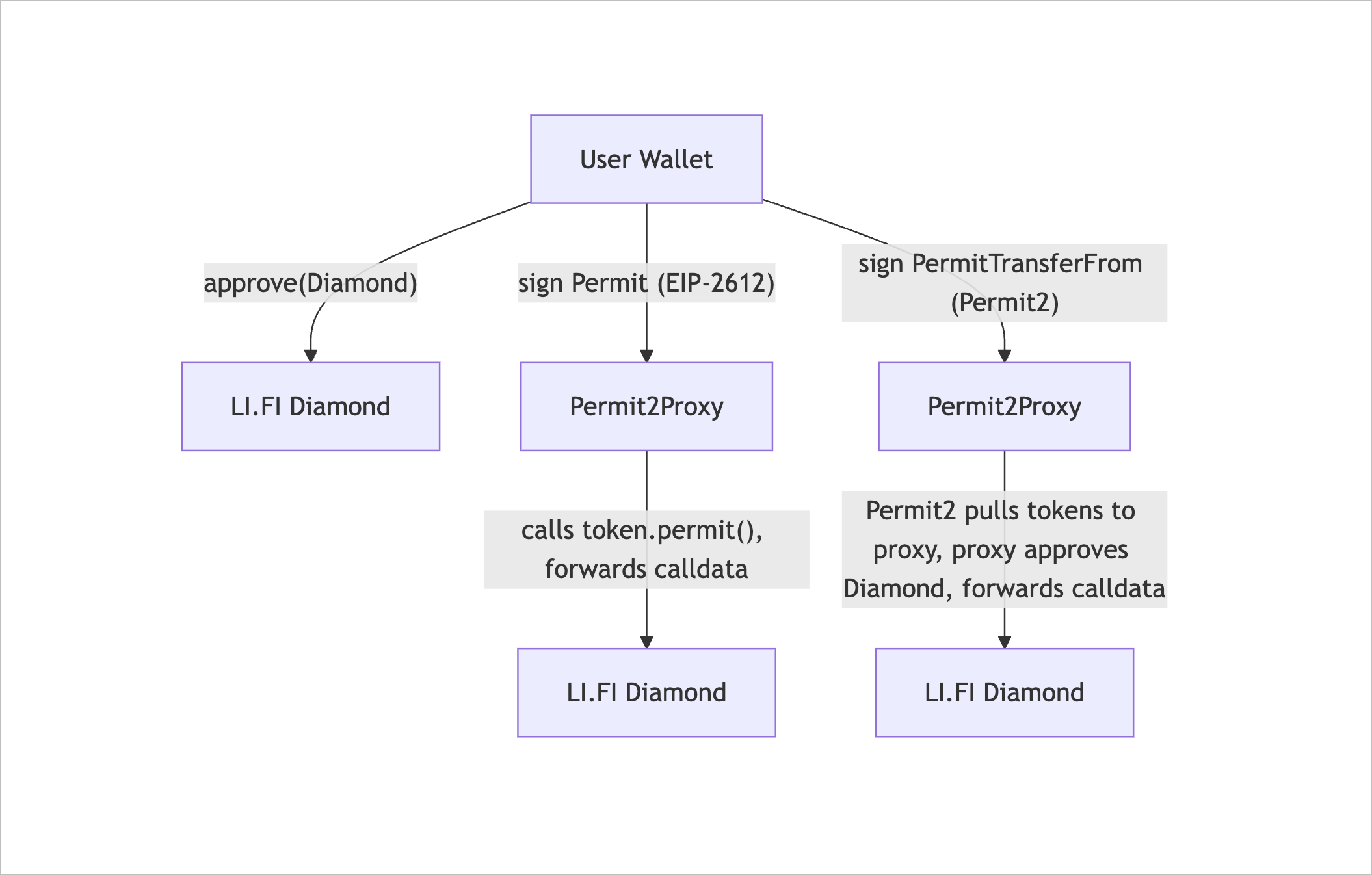 ### Key Addresses
| Contract | Address | Notes |
| ------------------- | -------------------------------------------- | ------------------------------------------------------------------------------------------------------------------------------------------------------------------------------------- |
| **LI.FI Diamond** | `0x1231DEB6f5749EF6cE6943a275A1D3E7486F4EaE` | Most EVM chains. Some networks use a different address — always query `GET /v1/chains` or check [Smart Contract Addresses](/introduction/lifi-architecture/smart-contract-addresses). |
| **Uniswap Permit2** | `0x000000000022D473030F116dDEE9F6B43aC78BA3` | Most EVM chains. Several networks use a different deployment (e.g. zkSync, Abstract, Lens, Flare, Sophon, XDC) — always read `permit2` from `GET /v1/chains`. |
| **Permit2Proxy** | Chain-specific | Query `GET /v1/chains` — each chain object includes `permit2` and `permit2Proxy` fields. |
### Discovering Addresses via the API
```ts theme={"system"}
const response = await fetch('https://li.quest/v1/chains');
const { chains } = await response.json();
const arbitrum = chains.find((c) => c.id === 42161);
console.log(arbitrum.permit2); // "0x000000000022D473030F116dDEE9F6B43aC78BA3"
console.log(arbitrum.permit2Proxy); // chain-specific Permit2Proxy address
console.log(arbitrum.diamondAddress); // "0x1231DEB6f5749EF6cE6943a275A1D3E7486F4EaE"
```
## API Flow: Permit2 (Standard Self-Execute)
This is the most common permit flow. It works with **any ERC-20 token** on chains where Permit2 is deployed.
Request a quote as usual. The response includes `estimate.approvalAddress` (the Diamond address for classic approve) and the chain metadata you need.
```ts theme={"system"}
const quote = await fetch('https://li.quest/v1/quote?' + new URLSearchParams({
fromChain: '42161',
toChain: '10',
fromToken: '0xaf88d065e77c8cC2239327C5EDb3A432268e5831', // USDC on Arbitrum
toToken: '0x0b2C639c533813f4Aa9D7837CAf62653d097Ff85', // USDC on Optimism
fromAmount: '10000000', // 10 USDC
fromAddress: '0xYourWalletAddress',
})).then(r => r.json());
```
The user needs to approve the **Permit2 contract** (not the Diamond) once. This only needs to happen if the user hasn't already approved Permit2 for this token.
Resolve the Permit2 and Permit2Proxy addresses from the chains API — do not hardcode them, as several networks use non-canonical deployments.
```ts theme={"system"}
import { createPublicClient, createWalletClient, http, maxUint256, parseAbi } from 'viem';
import { arbitrum } from 'viem/chains';
const publicClient = createPublicClient({ chain: arbitrum, transport: http() });
const walletClient = createWalletClient({ chain: arbitrum, transport: http(), account });
const chainsResponse = await fetch('https://li.quest/v1/chains').then(r => r.json());
const fromChain = chainsResponse.chains.find((c) => c.id === quote.action.fromChainId);
const permit2Address = fromChain.permit2;
const permit2ProxyAddress = fromChain.permit2Proxy;
const erc20Abi = parseAbi([
'function allowance(address owner, address spender) view returns (uint256)',
'function approve(address spender, uint256 amount) returns (bool)',
]);
const tokenAddress = quote.action.fromToken.address;
const allowance = await publicClient.readContract({
address: tokenAddress,
abi: erc20Abi,
functionName: 'allowance',
args: [account.address, permit2Address],
});
if (allowance < BigInt(quote.action.fromAmount)) {
const hash = await walletClient.writeContract({
address: tokenAddress,
abi: erc20Abi,
functionName: 'approve',
args: [permit2Address, maxUint256],
});
await publicClient.waitForTransactionReceipt({ hash });
}
```
Permit2 uses unordered nonces. The `Permit2Proxy` contract provides a `nextNonce()` helper that finds the next unused nonce for the signer.
```ts theme={"system"}
const permit2ProxyAbi = parseAbi([
'function nextNonce(address owner) view returns (uint256)',
'function callDiamondWithPermit2(bytes diamondCalldata, ((address token, uint256 amount) permitted, uint256 nonce, uint256 deadline) permit, bytes signature) external',
]);
const nonce = await publicClient.readContract({
address: permit2ProxyAddress,
abi: permit2ProxyAbi,
functionName: 'nextNonce',
args: [account.address],
});
```
Construct the EIP-712 typed data for `PermitTransferFrom`. The `spender` is the **Permit2Proxy** (not the Diamond).
```ts theme={"system"}
const deadline = BigInt(Math.floor(Date.now() / 1000) + 30 * 60); // 30 minutes
const permitTransferFrom = {
permitted: {
token: tokenAddress,
amount: BigInt(quote.action.fromAmount),
},
spender: permit2ProxyAddress,
nonce,
deadline,
};
const signature = await walletClient.signTypedData({
account,
primaryType: 'PermitTransferFrom',
domain: {
name: 'Permit2',
chainId: arbitrum.id,
verifyingContract: permit2Address,
},
types: {
TokenPermissions: [
{ name: 'token', type: 'address' },
{ name: 'amount', type: 'uint256' },
],
PermitTransferFrom: [
{ name: 'permitted', type: 'TokenPermissions' },
{ name: 'spender', type: 'address' },
{ name: 'nonce', type: 'uint256' },
{ name: 'deadline', type: 'uint256' },
],
},
message: permitTransferFrom,
});
```
Wrap the Diamond calldata inside a `callDiamondWithPermit2` call targeting the **Permit2Proxy**, not the Diamond.
```ts theme={"system"}
import { encodeFunctionData } from 'viem';
const diamondCalldata = quote.transactionRequest.data;
const txData = encodeFunctionData({
abi: permit2ProxyAbi,
functionName: 'callDiamondWithPermit2',
args: [
diamondCalldata,
[
[permitTransferFrom.permitted.token, permitTransferFrom.permitted.amount],
permitTransferFrom.nonce,
permitTransferFrom.deadline,
],
signature,
],
});
const txHash = await walletClient.sendTransaction({
to: permit2ProxyAddress,
data: txData,
value: BigInt(quote.transactionRequest.value ?? 0),
gasLimit: BigInt(quote.transactionRequest.gasLimit ?? 0),
});
```
Track the transaction status as you normally would using the `/status` endpoint.
```ts theme={"system"}
const getStatus = async (txHash) => {
const result = await fetch(`https://li.quest/v1/status?txHash=${txHash}`);
return result.json();
};
let status;
do {
status = await getStatus(txHash);
if (status.status === 'PENDING') await new Promise(r => setTimeout(r, 5000));
} while (status.status !== 'DONE' && status.status !== 'FAILED');
```
## API Flow: EIP-2612 Native Permit
EIP-2612 permits are only available for tokens that implement the `permit()` function (e.g., USDC, AAVE, UNI). No prior `approve()` transaction is needed at all.
Not all tokens support EIP-2612. DAI uses a non-standard permit signature that LI.FI does not currently support. If the token does not implement EIP-2612, fall back to classic `approve()` or Permit2.
### Detecting EIP-2612 Support
There is no on-chain registry or ERC-165 interface for EIP-2612. The only reliable method is to probe the token contract for the required functions. If `nonces()` and `DOMAIN_SEPARATOR()` both return successfully, the token supports EIP-2612.
```ts theme={"system"}
const eip2612DetectAbi = parseAbi([
'function nonces(address owner) view returns (uint256)',
'function DOMAIN_SEPARATOR() view returns (bytes32)',
]);
async function supportsEIP2612(tokenAddress: string): Promise {
try {
await Promise.all([
publicClient.readContract({
address: tokenAddress,
abi: eip2612DetectAbi,
functionName: 'nonces',
args: [account.address],
}),
publicClient.readContract({
address: tokenAddress,
abi: eip2612DetectAbi,
functionName: 'DOMAIN_SEPARATOR',
}),
]);
return true;
} catch {
return false;
}
}
```
Tokens deployed with OpenZeppelin v4.9+ or v5.x also expose `eip712Domain()` ([EIP-5267](https://eips.ethereum.org/EIPS/eip-5267)), which returns all domain fields in a single call. For older tokens, read `name()`, `version()`, and `DOMAIN_SEPARATOR()` separately and recompute the separator to validate it.
Same as the standard flow: request a quote, then use the `transactionRequest.data` as your diamond calldata.
EIP-2612 tokens track nonces per-owner. Read the current nonce from the token contract.
```ts theme={"system"}
const eip2612Abi = parseAbi([
'function nonces(address owner) view returns (uint256)',
'function name() view returns (string)',
'function version() view returns (string)',
'function DOMAIN_SEPARATOR() view returns (bytes32)',
]);
const [nonce, name, version] = await Promise.all([
publicClient.readContract({
address: tokenAddress, abi: eip2612Abi,
functionName: 'nonces', args: [account.address],
}),
publicClient.readContract({
address: tokenAddress, abi: eip2612Abi, functionName: 'name',
}),
publicClient.readContract({
address: tokenAddress, abi: eip2612Abi, functionName: 'version',
}),
]);
```
The `spender` is the **Permit2Proxy** address.
```ts theme={"system"}
const deadline = BigInt(Math.floor(Date.now() / 1000) + 30 * 60);
const permitSignature = await walletClient.signTypedData({
account,
primaryType: 'Permit',
domain: {
name,
version,
chainId: arbitrum.id,
verifyingContract: tokenAddress,
},
types: {
Permit: [
{ name: 'owner', type: 'address' },
{ name: 'spender', type: 'address' },
{ name: 'value', type: 'uint256' },
{ name: 'nonce', type: 'uint256' },
{ name: 'deadline', type: 'uint256' },
],
},
message: {
owner: account.address,
spender: permit2ProxyAddress,
value: BigInt(quote.action.fromAmount),
nonce,
deadline,
},
});
```
```ts theme={"system"}
import { parseSignature, encodeFunctionData } from 'viem';
const { v, r, s } = parseSignature(permitSignature);
const permit2ProxyEip2612Abi = parseAbi([
'function callDiamondWithEIP2612Signature(address tokenAddress, uint256 amount, uint256 deadline, uint8 v, bytes32 r, bytes32 s, bytes diamondCalldata) external payable',
]);
const txData = encodeFunctionData({
abi: permit2ProxyEip2612Abi,
functionName: 'callDiamondWithEIP2612Signature',
args: [
tokenAddress,
BigInt(quote.action.fromAmount),
deadline,
Number(v),
r,
s,
quote.transactionRequest.data,
],
});
const txHash = await walletClient.sendTransaction({
to: permit2ProxyAddress,
data: txData,
value: BigInt(quote.transactionRequest.value ?? 0),
});
```
## SDK Usage
The `@lifi/sdk` handles Permit2 automatically during route execution. No manual signature construction is needed.
```ts theme={"system"}
import { createConfig, EVM, executeRoute } from '@lifi/sdk';
import { createWalletClient, http } from 'viem';
import { arbitrum } from 'viem/chains';
createConfig({
integrator: 'your-integrator-id',
providers: [
EVM({
getWalletClient: () => Promise.resolve(walletClient),
}),
],
});
// The SDK automatically:
// 1. Checks if Permit2 is deployed on the source chain
// 2. Approves the Permit2 contract if needed (one-time)
// 3. Signs a PermitTransferFrom message per transaction
// 4. Encodes the calldata for Permit2Proxy
await executeRoute({ route });
```
To disable Permit2 and force classic `approve()` transactions:
```ts theme={"system"}
await executeRoute({
route,
executionOptions: {
disableMessageSigning: true,
},
});
```
## When Permit2 Is Not Used
The SDK skips Permit2 and falls back to classic `approve()` when:
* The source chain does not have Permit2 deployed (`chain.permit2` is not set)
* The source chain does not have a Permit2Proxy (`chain.permit2Proxy` is not set)
* The source token is the chain's native token (ETH, MATIC, etc.)
* Message signing is disabled (`disableMessageSigning: true`)
* The transaction uses batched execution (EIP-5792)
* The step's estimate has `skipApproval: true` or `skipPermit: true` (rare, optional fields only present on certain chain-specific steps such as Hyperliquid)
## Reference
### Permit2Proxy Contract Functions
| Function | Description |
| ------------------------------------------------------------------------------------ | ------------------------------------------------------------------------------------------------------ |
| `callDiamondWithPermit2(diamondCalldata, permit, signature)` | Transfers tokens via Permit2 `permitTransferFrom`, approves the Diamond, and forwards calldata. |
| `callDiamondWithEIP2612Signature(token, amount, deadline, v, r, s, diamondCalldata)` | Calls `permit()` on the EIP-2612 token, transfers tokens, approves the Diamond, and forwards calldata. |
| `nextNonce(owner)` | Returns the next available Permit2 nonce for the given address. |
### EIP-712 Type Definitions
**PermitTransferFrom** (Permit2 standard flow):
```json theme={"system"}
{
"TokenPermissions": [
{ "name": "token", "type": "address" },
{ "name": "amount", "type": "uint256" }
],
"PermitTransferFrom": [
{ "name": "permitted", "type": "TokenPermissions" },
{ "name": "spender", "type": "address" },
{ "name": "nonce", "type": "uint256" },
{ "name": "deadline", "type": "uint256" }
]
}
```
**Permit** (EIP-2612 native permit):
```json theme={"system"}
{
"Permit": [
{ "name": "owner", "type": "address" },
{ "name": "spender", "type": "address" },
{ "name": "value", "type": "uint256" },
{ "name": "nonce", "type": "uint256" },
{ "name": "deadline", "type": "uint256" }
]
}
```
### EIP-712 Domain
**Permit2** (for `PermitTransferFrom`):
```json theme={"system"}
{
"name": "Permit2",
"chainId": "",
"verifyingContract": ""
}
```
**EIP-2612** (for native `Permit` -- domain varies per token):
```json theme={"system"}
{
"name": "",
"version": "",
"chainId": "",
"verifyingContract": ""
}
```
### Key Addresses
| Contract | Address | Notes |
| ------------------- | -------------------------------------------- | ------------------------------------------------------------------------------------------------------------------------------------------------------------------------------------- |
| **LI.FI Diamond** | `0x1231DEB6f5749EF6cE6943a275A1D3E7486F4EaE` | Most EVM chains. Some networks use a different address — always query `GET /v1/chains` or check [Smart Contract Addresses](/introduction/lifi-architecture/smart-contract-addresses). |
| **Uniswap Permit2** | `0x000000000022D473030F116dDEE9F6B43aC78BA3` | Most EVM chains. Several networks use a different deployment (e.g. zkSync, Abstract, Lens, Flare, Sophon, XDC) — always read `permit2` from `GET /v1/chains`. |
| **Permit2Proxy** | Chain-specific | Query `GET /v1/chains` — each chain object includes `permit2` and `permit2Proxy` fields. |
### Discovering Addresses via the API
```ts theme={"system"}
const response = await fetch('https://li.quest/v1/chains');
const { chains } = await response.json();
const arbitrum = chains.find((c) => c.id === 42161);
console.log(arbitrum.permit2); // "0x000000000022D473030F116dDEE9F6B43aC78BA3"
console.log(arbitrum.permit2Proxy); // chain-specific Permit2Proxy address
console.log(arbitrum.diamondAddress); // "0x1231DEB6f5749EF6cE6943a275A1D3E7486F4EaE"
```
## API Flow: Permit2 (Standard Self-Execute)
This is the most common permit flow. It works with **any ERC-20 token** on chains where Permit2 is deployed.
Request a quote as usual. The response includes `estimate.approvalAddress` (the Diamond address for classic approve) and the chain metadata you need.
```ts theme={"system"}
const quote = await fetch('https://li.quest/v1/quote?' + new URLSearchParams({
fromChain: '42161',
toChain: '10',
fromToken: '0xaf88d065e77c8cC2239327C5EDb3A432268e5831', // USDC on Arbitrum
toToken: '0x0b2C639c533813f4Aa9D7837CAf62653d097Ff85', // USDC on Optimism
fromAmount: '10000000', // 10 USDC
fromAddress: '0xYourWalletAddress',
})).then(r => r.json());
```
The user needs to approve the **Permit2 contract** (not the Diamond) once. This only needs to happen if the user hasn't already approved Permit2 for this token.
Resolve the Permit2 and Permit2Proxy addresses from the chains API — do not hardcode them, as several networks use non-canonical deployments.
```ts theme={"system"}
import { createPublicClient, createWalletClient, http, maxUint256, parseAbi } from 'viem';
import { arbitrum } from 'viem/chains';
const publicClient = createPublicClient({ chain: arbitrum, transport: http() });
const walletClient = createWalletClient({ chain: arbitrum, transport: http(), account });
const chainsResponse = await fetch('https://li.quest/v1/chains').then(r => r.json());
const fromChain = chainsResponse.chains.find((c) => c.id === quote.action.fromChainId);
const permit2Address = fromChain.permit2;
const permit2ProxyAddress = fromChain.permit2Proxy;
const erc20Abi = parseAbi([
'function allowance(address owner, address spender) view returns (uint256)',
'function approve(address spender, uint256 amount) returns (bool)',
]);
const tokenAddress = quote.action.fromToken.address;
const allowance = await publicClient.readContract({
address: tokenAddress,
abi: erc20Abi,
functionName: 'allowance',
args: [account.address, permit2Address],
});
if (allowance < BigInt(quote.action.fromAmount)) {
const hash = await walletClient.writeContract({
address: tokenAddress,
abi: erc20Abi,
functionName: 'approve',
args: [permit2Address, maxUint256],
});
await publicClient.waitForTransactionReceipt({ hash });
}
```
Permit2 uses unordered nonces. The `Permit2Proxy` contract provides a `nextNonce()` helper that finds the next unused nonce for the signer.
```ts theme={"system"}
const permit2ProxyAbi = parseAbi([
'function nextNonce(address owner) view returns (uint256)',
'function callDiamondWithPermit2(bytes diamondCalldata, ((address token, uint256 amount) permitted, uint256 nonce, uint256 deadline) permit, bytes signature) external',
]);
const nonce = await publicClient.readContract({
address: permit2ProxyAddress,
abi: permit2ProxyAbi,
functionName: 'nextNonce',
args: [account.address],
});
```
Construct the EIP-712 typed data for `PermitTransferFrom`. The `spender` is the **Permit2Proxy** (not the Diamond).
```ts theme={"system"}
const deadline = BigInt(Math.floor(Date.now() / 1000) + 30 * 60); // 30 minutes
const permitTransferFrom = {
permitted: {
token: tokenAddress,
amount: BigInt(quote.action.fromAmount),
},
spender: permit2ProxyAddress,
nonce,
deadline,
};
const signature = await walletClient.signTypedData({
account,
primaryType: 'PermitTransferFrom',
domain: {
name: 'Permit2',
chainId: arbitrum.id,
verifyingContract: permit2Address,
},
types: {
TokenPermissions: [
{ name: 'token', type: 'address' },
{ name: 'amount', type: 'uint256' },
],
PermitTransferFrom: [
{ name: 'permitted', type: 'TokenPermissions' },
{ name: 'spender', type: 'address' },
{ name: 'nonce', type: 'uint256' },
{ name: 'deadline', type: 'uint256' },
],
},
message: permitTransferFrom,
});
```
Wrap the Diamond calldata inside a `callDiamondWithPermit2` call targeting the **Permit2Proxy**, not the Diamond.
```ts theme={"system"}
import { encodeFunctionData } from 'viem';
const diamondCalldata = quote.transactionRequest.data;
const txData = encodeFunctionData({
abi: permit2ProxyAbi,
functionName: 'callDiamondWithPermit2',
args: [
diamondCalldata,
[
[permitTransferFrom.permitted.token, permitTransferFrom.permitted.amount],
permitTransferFrom.nonce,
permitTransferFrom.deadline,
],
signature,
],
});
const txHash = await walletClient.sendTransaction({
to: permit2ProxyAddress,
data: txData,
value: BigInt(quote.transactionRequest.value ?? 0),
gasLimit: BigInt(quote.transactionRequest.gasLimit ?? 0),
});
```
Track the transaction status as you normally would using the `/status` endpoint.
```ts theme={"system"}
const getStatus = async (txHash) => {
const result = await fetch(`https://li.quest/v1/status?txHash=${txHash}`);
return result.json();
};
let status;
do {
status = await getStatus(txHash);
if (status.status === 'PENDING') await new Promise(r => setTimeout(r, 5000));
} while (status.status !== 'DONE' && status.status !== 'FAILED');
```
## API Flow: EIP-2612 Native Permit
EIP-2612 permits are only available for tokens that implement the `permit()` function (e.g., USDC, AAVE, UNI). No prior `approve()` transaction is needed at all.
Not all tokens support EIP-2612. DAI uses a non-standard permit signature that LI.FI does not currently support. If the token does not implement EIP-2612, fall back to classic `approve()` or Permit2.
### Detecting EIP-2612 Support
There is no on-chain registry or ERC-165 interface for EIP-2612. The only reliable method is to probe the token contract for the required functions. If `nonces()` and `DOMAIN_SEPARATOR()` both return successfully, the token supports EIP-2612.
```ts theme={"system"}
const eip2612DetectAbi = parseAbi([
'function nonces(address owner) view returns (uint256)',
'function DOMAIN_SEPARATOR() view returns (bytes32)',
]);
async function supportsEIP2612(tokenAddress: string): Promise {
try {
await Promise.all([
publicClient.readContract({
address: tokenAddress,
abi: eip2612DetectAbi,
functionName: 'nonces',
args: [account.address],
}),
publicClient.readContract({
address: tokenAddress,
abi: eip2612DetectAbi,
functionName: 'DOMAIN_SEPARATOR',
}),
]);
return true;
} catch {
return false;
}
}
```
Tokens deployed with OpenZeppelin v4.9+ or v5.x also expose `eip712Domain()` ([EIP-5267](https://eips.ethereum.org/EIPS/eip-5267)), which returns all domain fields in a single call. For older tokens, read `name()`, `version()`, and `DOMAIN_SEPARATOR()` separately and recompute the separator to validate it.
Same as the standard flow: request a quote, then use the `transactionRequest.data` as your diamond calldata.
EIP-2612 tokens track nonces per-owner. Read the current nonce from the token contract.
```ts theme={"system"}
const eip2612Abi = parseAbi([
'function nonces(address owner) view returns (uint256)',
'function name() view returns (string)',
'function version() view returns (string)',
'function DOMAIN_SEPARATOR() view returns (bytes32)',
]);
const [nonce, name, version] = await Promise.all([
publicClient.readContract({
address: tokenAddress, abi: eip2612Abi,
functionName: 'nonces', args: [account.address],
}),
publicClient.readContract({
address: tokenAddress, abi: eip2612Abi, functionName: 'name',
}),
publicClient.readContract({
address: tokenAddress, abi: eip2612Abi, functionName: 'version',
}),
]);
```
The `spender` is the **Permit2Proxy** address.
```ts theme={"system"}
const deadline = BigInt(Math.floor(Date.now() / 1000) + 30 * 60);
const permitSignature = await walletClient.signTypedData({
account,
primaryType: 'Permit',
domain: {
name,
version,
chainId: arbitrum.id,
verifyingContract: tokenAddress,
},
types: {
Permit: [
{ name: 'owner', type: 'address' },
{ name: 'spender', type: 'address' },
{ name: 'value', type: 'uint256' },
{ name: 'nonce', type: 'uint256' },
{ name: 'deadline', type: 'uint256' },
],
},
message: {
owner: account.address,
spender: permit2ProxyAddress,
value: BigInt(quote.action.fromAmount),
nonce,
deadline,
},
});
```
```ts theme={"system"}
import { parseSignature, encodeFunctionData } from 'viem';
const { v, r, s } = parseSignature(permitSignature);
const permit2ProxyEip2612Abi = parseAbi([
'function callDiamondWithEIP2612Signature(address tokenAddress, uint256 amount, uint256 deadline, uint8 v, bytes32 r, bytes32 s, bytes diamondCalldata) external payable',
]);
const txData = encodeFunctionData({
abi: permit2ProxyEip2612Abi,
functionName: 'callDiamondWithEIP2612Signature',
args: [
tokenAddress,
BigInt(quote.action.fromAmount),
deadline,
Number(v),
r,
s,
quote.transactionRequest.data,
],
});
const txHash = await walletClient.sendTransaction({
to: permit2ProxyAddress,
data: txData,
value: BigInt(quote.transactionRequest.value ?? 0),
});
```
## SDK Usage
The `@lifi/sdk` handles Permit2 automatically during route execution. No manual signature construction is needed.
```ts theme={"system"}
import { createConfig, EVM, executeRoute } from '@lifi/sdk';
import { createWalletClient, http } from 'viem';
import { arbitrum } from 'viem/chains';
createConfig({
integrator: 'your-integrator-id',
providers: [
EVM({
getWalletClient: () => Promise.resolve(walletClient),
}),
],
});
// The SDK automatically:
// 1. Checks if Permit2 is deployed on the source chain
// 2. Approves the Permit2 contract if needed (one-time)
// 3. Signs a PermitTransferFrom message per transaction
// 4. Encodes the calldata for Permit2Proxy
await executeRoute({ route });
```
To disable Permit2 and force classic `approve()` transactions:
```ts theme={"system"}
await executeRoute({
route,
executionOptions: {
disableMessageSigning: true,
},
});
```
## When Permit2 Is Not Used
The SDK skips Permit2 and falls back to classic `approve()` when:
* The source chain does not have Permit2 deployed (`chain.permit2` is not set)
* The source chain does not have a Permit2Proxy (`chain.permit2Proxy` is not set)
* The source token is the chain's native token (ETH, MATIC, etc.)
* Message signing is disabled (`disableMessageSigning: true`)
* The transaction uses batched execution (EIP-5792)
* The step's estimate has `skipApproval: true` or `skipPermit: true` (rare, optional fields only present on certain chain-specific steps such as Hyperliquid)
## Reference
### Permit2Proxy Contract Functions
| Function | Description |
| ------------------------------------------------------------------------------------ | ------------------------------------------------------------------------------------------------------ |
| `callDiamondWithPermit2(diamondCalldata, permit, signature)` | Transfers tokens via Permit2 `permitTransferFrom`, approves the Diamond, and forwards calldata. |
| `callDiamondWithEIP2612Signature(token, amount, deadline, v, r, s, diamondCalldata)` | Calls `permit()` on the EIP-2612 token, transfers tokens, approves the Diamond, and forwards calldata. |
| `nextNonce(owner)` | Returns the next available Permit2 nonce for the given address. |
### EIP-712 Type Definitions
**PermitTransferFrom** (Permit2 standard flow):
```json theme={"system"}
{
"TokenPermissions": [
{ "name": "token", "type": "address" },
{ "name": "amount", "type": "uint256" }
],
"PermitTransferFrom": [
{ "name": "permitted", "type": "TokenPermissions" },
{ "name": "spender", "type": "address" },
{ "name": "nonce", "type": "uint256" },
{ "name": "deadline", "type": "uint256" }
]
}
```
**Permit** (EIP-2612 native permit):
```json theme={"system"}
{
"Permit": [
{ "name": "owner", "type": "address" },
{ "name": "spender", "type": "address" },
{ "name": "value", "type": "uint256" },
{ "name": "nonce", "type": "uint256" },
{ "name": "deadline", "type": "uint256" }
]
}
```
### EIP-712 Domain
**Permit2** (for `PermitTransferFrom`):
```json theme={"system"}
{
"name": "Permit2",
"chainId": "",
"verifyingContract": ""
}
```
**EIP-2612** (for native `Permit` -- domain varies per token):
```json theme={"system"}
{
"name": "",
"version": "",
"chainId": "",
"verifyingContract": ""
}
```