

The four deployed programs
The current deployment splits the system into four programs, each with one job. The same program IDs are used on devnet and mainnet-beta.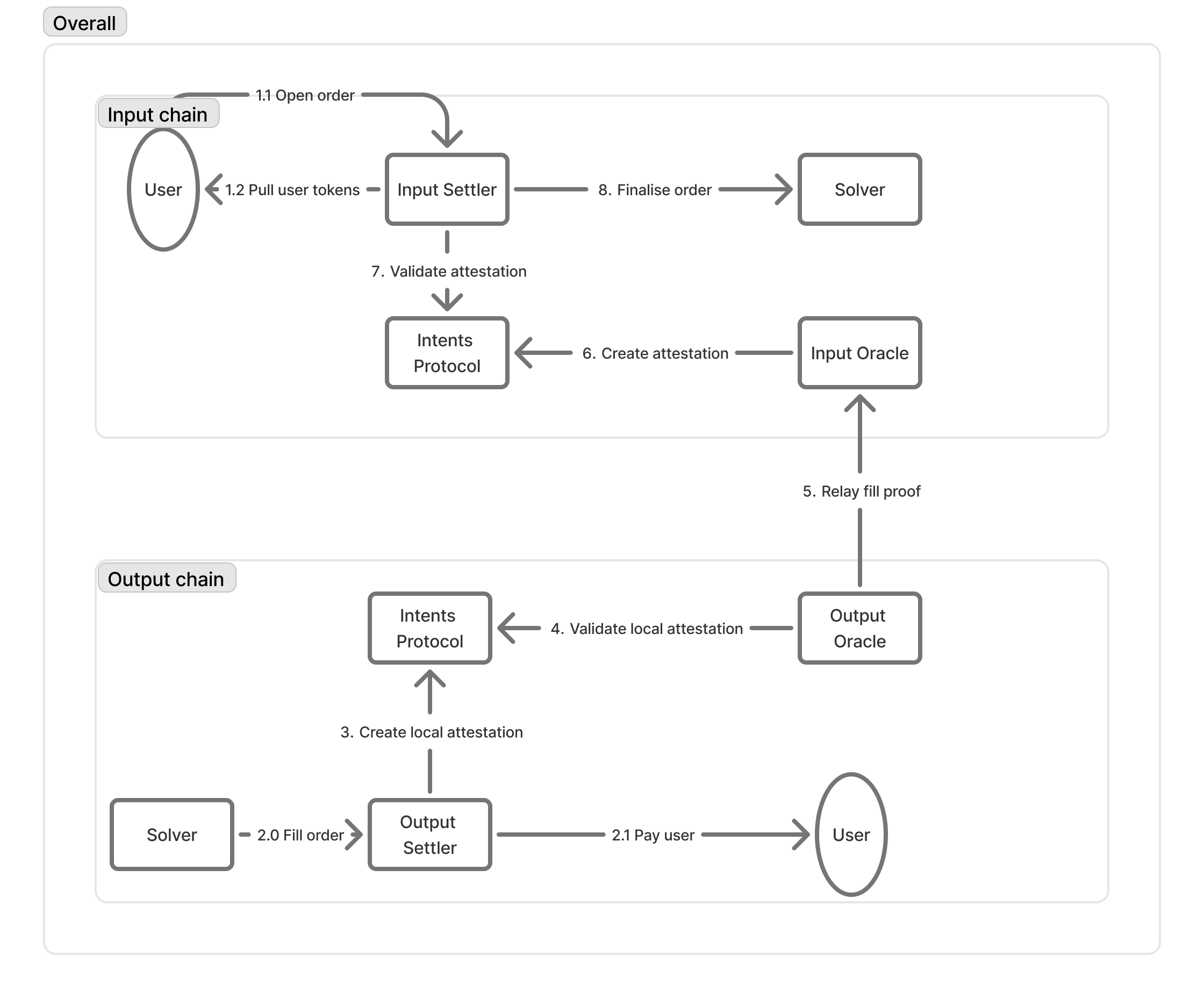
Program IDs and derived accounts
A program ID identifies executable code. Most instructions also require singleton program-derived accounts (PDAs) that hold the deployed program’s state. These addresses are deterministic and are the same on devnet and mainnet-beta because both clusters use the same program IDs and seeds; their stored configuration is cluster-specific.
Anchor clients can resolve these PDAs from the seed metadata in the published IDLs. Other clients can derive them locally with
PublicKey.findProgramAddressSync([Buffer.from(seed)], programId). A plain RPC lookup cannot infer an unknown program’s PDA seeds.
The Polymer PDA stores its configured prover program ID, currently CdvSq48QUukYuMczgZAVNZrwcHNshBdtqrjW26sQiGPs on both clusters. Read that field from the OraclePolymer account instead of duplicating it in order data. Chain mappings, order contexts, fill records, token accounts, and attestations depend on a chain or order and are derived as needed; they are not deployment addresses. Order contexts and fill records must be derived client-side — see Program IDLs.
Wormhole also has a mainnet deployment; see the deployment overview. The bundled Wormhole IDL is a source-interface reference with a different embedded address; do not use that address as the mainnet deployment address.
Which identity goes in which field
Every 32-byte identity slot in an order names a specific account, and program IDs and state PDAs are not interchangeable. Each rule applies to a specific leg: theMandateOutput rows below hold when that output is on Solana (an EVM output carries EVM identities instead), and the input_oracle row holds when the order is opened on Solana.
For a same-chain Solana → Solana order, no oracle program participates, and one rule applies: all three slots —
input_oracle, output.oracle, and output.settler — hold the output-settler state PDA (DHShHmVkTwCzUzAQbCu4GDqJmursuDscNR6o4hTBgeRy). LI.FI’s builder and tooling encode same-chain orders this way. It is the identity input-first settlement requires, because that route rebuilds all three slots from the settler itself. The same order also settles through the standard fill → finalise route.
On the standard route, the fill’s
LocalAttestation names output.oracle as its consumer. With the canonical encoding that consumer is the output settler rather than the escrow, so finalise validates the attestation but does not consume it, and its rent (about 0.0012 SOL, paid by the filler) is not reclaimed. Setting output.oracle to the input_settler_escrow program ID would let finalise consume the attestation and return that rent, but the order would then no longer be eligible for input-first settlement. LI.FI uses the canonical encoding.Order structure
Every Solana intent is aStandardOrder. The user commits one input on Solana and describes the output that solvers must deliver — on Solana or on an EVM chain.
The struct carries a
Vec of outputs, but an order opened on Solana has exactly one output in practice: open rejects any order whose projected finalise transaction would not fit, and two outputs already exceed the limit (see Opening). Orders that originate on another chain can still send several outputs to Solana.order_id = keccak256(borsh_serialize(StandardOrder)). Any party can recompute it, which is what makes the PDA-based bookkeeping below work. The full type definitions, including Borsh layouts, are in the program IDLs.
Although
MandateOutput.amount and the Dutch-auction slope travel as 32-byte values, Solana narrows them to u64 at fill time. A value above u64::MAX makes the output unfillable (AmountTooLarge / ArithmeticOverflow).Input settlement: input_settler_escrow
The input settler is an escrow. Opening an order moves the user’s tokens into an escrow account; they leave it exactly once — to the solver at finalise or finalise_with_prefill, or back to the user at refund or refund_on_non_fill. All four paths close the order’s context PDA, so once one succeeds the others can never execute.
Program state
Three account types track an order’s life:Opening
open(order) escrows the input: it transfers order.input.amount from the user’s token account into an associated token account owned by the order’s OrderContext PDA. The instruction needs two signers — the user, who must equal order.user and authorizes the token debit, and a sponsor, who pays the rent for the order’s accounts. The sponsor does not have to be the transaction fee payer, and it can be the same key as the user. The sponsor receives the escrow token account and order_context rent back when the order settles; the consumed_order rent is never returned — that PDA is a permanent replay guard — so budget it as a per-order cost when sponsoring opens.
Before moving funds, open validates the order: fill_deadline must not have passed (it may equal the current time), expires must be strictly in the future and after fill_deadline, the order must have outputs, and the chain id and input mint must match the order. It also estimates the size of the eventual finalise transaction and rejects the order (FinaliseTxTooLarge) if the estimate exceeds 1142 bytes — the 1232-byte packet limit minus 90 bytes of headroom for ComputeBudget instructions:
callback_data and context combined. Two outputs project to at least 1,332 bytes, so a Solana-origin order cannot have more than one output.
A successful open emits an OpenEvent carrying the order_id and the full StandardOrder — this event is how the order server and solvers discover on-chain opens.
Rent returns
Every settlement path —finalise, finalise_with_prefill, refund, refund_on_non_fill — closes the escrow token account and order_context and sends both rents to the sponsor. If the sponsor account is executable (a program), both rents go to the settlement signer instead: the solver for either finalization route, the signer for either refund. If that account is also executable, the instruction fails with ExecutableRentRefundAccount.
Settlement
finalise(order, solve_params) pays the solver. It verifies that every output was filled, then transfers the escrowed funds to the solver’s chosen destination and closes the order’s accounts. solve_params contains one { solver, timestamp } entry per output, in output order, and the solver of output 0 — the canonical solver for the order — must sign. Besides the escrow accounts, the instruction takes the escrow’s local_consumer PDA and the intents_protocol program, which it uses to consume local attestations committed to the escrow.
remaining_accounts carries two entries per output: first one attestation per output, then one rent-refund account per output, both in output order:
- The attestation is a
LocalAttestationfor a same-chain output, or anAttestationcreated by the order’sinput_oraclefor a cross-chain one. - The rent-refund slot matters only for a local attestation whose committed consumer is the escrow program (
output.oracle=input_settler_escrowprogram ID). Then both accounts must be writable and the refund account must be the attestation’s storedrent_refund;finaliseconsumes the attestation and returns its rent. - For every other attestation — remote ones, and same-chain ones using the canonical encoding — the slot is required but ignored. Any existing account works, such as the system program, and both entries may be read-only.
WrongAttestationCount. The transaction shape and solver guidance are in Settlement.
Settlement emits a FinalisedEvent. Its settler field is the order’s order_context PDA, not the escrow singleton or the program ID:
transfer_checked inner instruction. For a Token-2022 transfer-fee mint, the destination receives that amount minus the fee.
Input-first settlement (finalise_with_prefill)
finalise_with_prefill(order_id) pays the solver before delivering the output. It supports one-output Solana orders whose compact fields can reconstruct the canonical StandardOrder. See Input-first Solana settlement for the solver workflow.
The instruction scans the Instructions sysvar for exactly one later fill_samechain or native_fill_samechain. The fill must be top level, signed by the same solver, and carry the same order_id.
The escrow reconstructs the order from the compact payload and authenticated accounts. It verifies the order hash, the exact account count (10 for fill_samechain, 5 for native_fill_samechain), the ordered account addresses, the canonical token accounts, the fill_record PDA, and the fixed program IDs. Any mismatch fails the transaction and rolls back the escrow release.
No deadline check is needed here. fill_deadline is part of order_id, and the fill itself refuses a passed deadline, so a fill that executes was on time.
Both settlement instructions must be top level (NotTopLevel). The settler does not inspect the instructions between them, so those instructions may swap, mint, or create accounts. The complete transaction must still fit Solana’s size, compute, and account-lock limits.
The compact fills do not create a LocalAttestation: settlement already happened earlier in the same transaction, so there is nothing left to prove. They create only the FillRecord.
Settlement emits the same FinalisedEvent as finalise, with settler set to the order_context PDA. The escrow sweeps its full live balance, so tokens sent to the escrow after open are paid out too; read the amounts from the transfer_checked inner instruction.
Refunds
Escrowed funds always return toorder.user, through one of two permissionless paths:
refund(order)— anyone can call it onceorder.expiresis reached (now >= expires).refund_on_non_fill(order, output_index)— anyone can call it as soon as one output is proven not filled, which can happen right afterfill_deadlinepasses. One proven non-fill refunds the whole order, becausefinaliseneeds every output proven filled. It takes the escrow’slocal_consumerPDA and theintents_protocolprogram, and exactly tworemaining_accounts:[attestation, rent_refund], with the same consume-or-ignore rules asfinalise. How the not-filled proof is produced is described under non-fill attestations.
finalise rejects fills with timestamp > fill_deadline (FilledTooLate), and the settlement paths exclude each other through the order_context PDA.
Output settlement: output_settler_simple
The output settler delivers outputs on Solana and records each delivery in a FillRecord; ordinary fills also create a LocalAttestation. It supports classic SPL tokens, compatible Token-2022 tokens, and native SOL.
Order types
Each output’scontext field encodes its order type: the first byte selects the type, the rest is type-specific payload with all integers big-endian.
Any other type byte fails with
NotImplemented; a wrong payload length fails with InvalidContextDataLength. The pricing formulas behind these types are shared with EVM — see Auctions.
The compact same-chain fills reach only two of these types: an empty context and the exclusive limit. A Dutch auction, an exclusive Dutch auction, or a limit order written as an explicit 0x00 byte must go through fill or native_fill.
Fills
Four instructions deliver outputs. The standard pair takes a fullMandateOutput; the compact pair takes the smaller payload used by input-first settlement.
fill(order_id, mandate_output, fill_deadline, filler_data)— classic SPL and compatible Token-2022 outputs. It transfers the tokens to the recipient, creates theFillRecordandLocalAttestationaccounts, and emits anOutputFilledEvent. Theorder_idis the input-chain identifier; it is not validated at fill time.native_fill(...)— native-SOL outputs. The output token must be the zero address[0; 32]; the transfer goes through the system program.fill_samechain(args)andnative_fill_samechain(args)— the same two deliveries, driven by aCompactSamechainOrderinstead of aMandateOutput. Both must be called as top-level instructions (NotTopLevel), both record the signer as the solver rather than reading afiller_datafield, and both create only aFillRecord— noLocalAttestation. Use them only after a matchingfinalise_with_prefillin the same transaction.
oracle and settler and carries no callback_data. ExclusiveFor uses the exclusive_for key it carries; only ExclusiveForSelf expands into the signer’s own key. None expands to an empty context, so an order whose context is an explicit 0x00 byte cannot be filled this way.
filler_data is the 32-byte solver id recorded for the origin-chain claim; it is not derived from or compared with the Solana filler signer. Choose an identity that can authorize finalization on the input chain. In particular, when the input is on Solana, it must be the raw public-key bytes of the Solana signer that will call finalise.
The instruction accounts and failure conditions are defined by the program IDL and the validation rules above.
output_settler_simple requires callback_data to be empty. There is no post-fill callback execution on Solana.Fill records
Every fill instruction creates aFillRecord PDA — the double-fill guard: its existence blocks a second fill of the same output. The instructions name this account fill_record; attest_not_filled names the same address fill_id. Its seeds are [order_id, mandate_output_hash] — with no string prefix, unlike most PDAs in the system.
mandate_output_hash is the keccak-256 of the output’s packed encoding, not its Borsh encoding:
chain_id and amount are their 32-byte big-endian values. The order_id seed is the origin chain’s order identifier, byte for byte: the Borsh hash from Order structure for a Solana-origin order, or the origin chain’s own order ID otherwise. A fill recorded under any other value cannot settle the order.
Once close_after has passed (strictly), anyone can call close_fill_record(order_id, output_hash) to close the record and return its rent to the recorded filler; the caller cannot redirect it. The timing is chosen so a record cannot be closed while a not-filled proof could still be created for that output. Closing emits FillRecordClosedEvent. Closing too early fails with FillRecordNotClosable.
Not-filled attestations
After an output’sfill_deadline passes, anyone can call attest_not_filled to attest that the output was never filled. It requires the output’s FillRecord PDA to be uninitialized — an output cannot be attested as not filled while its fill record exists — and creates a not-filled LocalAttestation, which unlocks the early refund path (refund_on_non_fill) on the input chain.
The attestation can only be created within a 48-hour window:
FillDeadlineNotPassed; calling it after the window fails with NotFilledWindowElapsed. The window limits when the proof can be created, not how long it stays valid: a proof created in time can still be used for refund_on_non_fill later. If nobody creates one in time, the order can still be refunded through refund once it expires.
A non-fill refund cannot be undone: finalise rejects any fill timestamped after the order’s signed fill_deadline (FilledTooLate), and the refund closes the order.
Attestations
On EVM chains, proof that an output was filled lives in contract storage behind validation interfaces. Solana takes a different route: proofs are accounts. When a fill is validated, the protocol creates a PDA whose address is derived from the fill’s content — so an account at the expected address is the proof. For aLocalAttestation, the account must also not be marked consumed (see Consuming local attestations).
An attestation account is not a signature. It is a deterministic PDA that is created only when a specific fill — or proof of a fill — has been validated according to the protocol rules.
- A
LocalAttestationis created on Solana when an output is filled there withfillornative_fill(the compact fills do not create one). It proves the fill on the chain where it happened. - An
Attestationis created on Solana after an oracle verifies a remote proof or message. It represents a fill that happened on another chain.
intents_protocol program (IDL: intents_protocol.json).
Pass only the seeds listed above to
PublicKey.findProgramAddressSync(seeds, programId). It finds and returns the bump automatically; do not append a bump to that input seed list. The returned bump is used separately when recreating or validating the PDA.
What is being attested
An attestation commits to a payload describing what happened to one output. Two payload kinds exist, distinguished by a 4-byte magic prefix:- A
FillDescriptionsays an output was filled. Its magic is the first 4 bytes ofkeccak("OIF.Fill")(0xd1252dff), and its layout isMAGIC || solver (32B) || order_id (32B) || timestamp (u32 BE) || common_payload. - A
NotFilledDescriptionsays an output was not filled before its deadline. Its magic is the first 4 bytes ofkeccak("OIF.NotFilled")(0x830c1e1c), and its layout isMAGIC || order_id (32B) || fill_deadline (u32 BE) || common_payload.
common_payload encodes the output itself: TOKEN (32B) || AMOUNT (32B) || RECIPIENT (32B) || CALLBACK_LENGTH (u16 BE) + CALLBACK_DATA || CONTEXT_LENGTH (u16 BE) + CONTEXT. This packed, big-endian encoding is separate from the Borsh encoding used for instruction arguments and accounts.
A fill description is hashed two ways, and the difference matters when you debug a failed finalization:
data_hash, used byLocalAttestation, is the keccak of the description without the timestamp. The timestamp is stored in the account and validated separately.payload_hash, used byAttestation, is the keccak of the full description, timestamp included.
fill_deadline.
Length prefixes are
u16, so callback_data and context are each capped at 65,535 bytes. The encoding is byte-compatible with the EVM implementation’s MandateOutputEncodingLib, locked by cross-implementation test vectors.LocalAttestation: fills on Solana
When the output settler completes a fill, it computes thedata_hash and creates the LocalAttestation by CPI into intents_protocol. The account’s address is derived from b"local_attestation", the attestator (the output settler PDA that signed the CPI), the consumer, the data_hash, and the bump returned by PDA derivation. The consumer is a 32-byte identifier for whoever is expected to consume the proof on the output chain — typically the output-side oracle program. The seed format is enforced on-chain by validate_local_attestation(...) in intents_protocol.
The timestamp comes from the Solana clock at fill time, converted to u32 with a checked conversion (an out-of-range clock fails with InvalidTimestamp).
The account stores:
Consuming local attestations
ALocalAttestation is single-use for its committed consumer. When the consumer uses the proof irreversibly, it consumes the attestation through intents_protocol::consume_local_attestation, which validates the PDA, stored timestamp, and stored rent_refund, then closes the account and returns its rent to rent_refund. The authority signing the consume must be the consumer itself or its program’s ["local_consumer"] PDA.
Anything else — including a same-chain attestation under the canonical encoding, whose consumer is the output settler — is validated but never consumed, and its rent stays locked.
If the stored
rent_refund is an executable account, consumption still succeeds: the account is kept, marked consumed = true, and LocalAttestationRentDeferredEvent is emitted. reclaim_local_attestation_rent closes it later, and its destination must not be executable. Anyone can call it to return the rent to the recorded rent_refund once that account is no longer executable. To send the rent anywhere else, the recorded rent_refund must sign as rent_refund_authority. Only consumed attestations can be reclaimed (LocalAttestationNotConsumed).
A consumed attestation — closed, or kept with consumed = true — is no longer a valid proof, so it cannot be exported or used for settlement again.
Attestation: proofs received from an oracle
When an oracle program verifies a remote proof — a Wormhole VAA, a Polymer proof — it registers each proven payload on Solana by CPI intointents_protocol. The address is derived from b"attestation", the attestator (the input-side oracle named by order.input_oracle), chain_id.to_le_bytes() (little-endian u128), source, application, the payload_hash, and the bump returned by PDA derivation. Enforced on-chain by validate_attestation(...).
The source and application seeds bind a proof to where it came from and what emitted it:
source— the 32-byte identifier of the oracle or emitter on the output chain.application— the 32-byte identifier of the output settler, typicallyMandateOutput.settler.
chain_id from output.chain_id, source from output.oracle, and application from output.settler.
This is why an order’s
MandateOutput.oracle and MandateOutput.settler must be the correct output-chain identifiers for the oracle system you use. If they are wrong, the proof lands at a PDA the finalization will never look at.The proof flow end to end
The two account types are the two halves of one relay, and they live on different chains. Steps 1 and 2 below run on the output chain (when an output is filled on Solana); steps 3 and 4 run on the input chain (when a Solana order awaits proof of a remote fill). For a single cross-chain order, Solana plays one of the two roles. A same-chain Solana order skips the relay entirely: finalization validates the fill’sLocalAttestation directly (step 4).
1
Fill creates a LocalAttestation (output chain)
A solver fills an output on Solana through
output_settler_simple. The settler transfers the assets, creates a FillRecord PDA against double fills, and creates a LocalAttestation committing to the fill’s content and timestamp.2
The output-side oracle validates it (output chain)
On the output chain, the oracle checks that the
LocalAttestation exists at the correct PDA, is not consumed, and that its stored timestamp matches the payload: decode the FillDescription, recompute the data_hash without the timestamp, validate the PDA. Polymer’s submit only validates; submit_consume and Wormhole’s submit also consume the attestation.3
The input-side oracle creates an Attestation (input chain)
On the input chain, the oracle verifies its own proof format — a Wormhole VAA or a Polymer proof — and creates one
Attestation per proven payload_hash. The per-oracle details are in Oracle systems.4
Finalization checks one attestation per output (input chain)
When the solver calls
finalise, the input settler validates one attestation account per output, passed via remaining_accounts together with one rent-refund slot per output. A same-chain output expects a LocalAttestation whose timestamp matches the output’s SolveParams.timestamp; a cross-chain output expects an Attestation at the PDA derived from (input_oracle, chain_id, source, application, payload_hash).Non-fill attestations (early refunds)
The same two primitives carry proof that an output was not filled, which unlocks a refund before the order expires:- On the output chain,
output_settler_simple::attest_not_filledcreates aLocalAttestationwhosedata_hashis the keccak of the fullNotFilledDescriptionand whose stored timestamp is the output’sfill_deadline. - Oracles relay it exactly like a fill payload — the
NOT_FILLED_MAGICprefix selects the not-filled hashing rule on both sides. - On the input chain,
refund_on_non_fillvalidates the resultingLocalAttestation(same-chain) orAttestation(cross-chain) and refunds the escrow without waiting forexpires— see Refunds. - The not-filled
LocalAttestationcan only be created within 48 hours afterfill_deadline— see Not-filled attestations.
Chain configuration
intents_protocol also stores the configuration the attestation system depends on:
ChainId— a singleton PDA (seed"chain_id") holding the deployment’s canonical chain id.set_chain_id(chain_id)can be called exactly once, by any signer — deployments run it as the very first step, before anyone else can claim it. Settler programs copy the value at their owninitialize.ChainMapping— a PDA (seeds["chain_mapping", oracle, protocol_chain_id_le]) that maps a messaging protocol’s chain id to the canonical chain id. Each protocol has its own scheme: Polymer uses EVM chain ids for EVM chains but its own protocol id for Solana (2), and Wormhole uses its ownu16ids. Each oracle’s owner creates the mappings through the oracle’sset_chain_mapping(protocol_chain_id, chain_id)instruction — owner-only, and each mapping can be set only once. Cross-chain attesting needs these mappings: if a proof arrives from a chain with no mapping, it cannot be registered.
Events
intents_protocol emits an Anchor event for every state change, which indexers can subscribe to:
LocalAttestationCreatedEventLocalAttestationConsumedEvent { attestator, consumer, data_hash, rent_refund }LocalAttestationRentDeferredEvent { local_attestation, rent_refund }— consumed, but the rent is held becauserent_refundis executableLocalAttestationRentReclaimedEvent { local_attestation, rent_refund }AttestationCreatedEventChainIdConfiguredEventChainMapConfiguredEvent
input_settler_escrow—OpenEvent,FinalisedEvent(both finalization routes),RefundedEventoutput_settler_simple—OutputFilledEvent,OutputNotFilledEvent,FillRecordClosedEvent { order_id, output_hash, rent_refund }polymerandwormhole—OutputProvenEvent
Common pitfalls
- Wrong 32-byte identifiers. Every system has its own 32-byte representation: Solana
Pubkey::to_bytes(), EVM addresses left-padded to 32 bytes, Wormhole emitter addresses. Mixing them up produces a PDA the validator will never find. - Each identity field fails at a different stage. Check all three against the identity matrix before filling:
- If
MandateOutput.settleris wrong, the fill is rejected. The order stays unfillable and refunds at expiry. - If
StandardOrder.input_oracleis wrong, finalization derives the expectedAttestationaddress using the wrong attestator, so it never finds the attestation the oracle actually created. - If
MandateOutput.oracleis wrong, the fill still succeeds, because this field is not checked at fill time. The solver’s assets leave immediately; proof submission later rejects the attestation, and the solver is not repaid.
- If
- Timestamp mismatches. Same-chain validation requires
LocalAttestation.timestamp == SolveParams.timestamp. If the solver passes a different timestamp than the one the output settler stored, finalization fails. - Missing rent-refund slots.
finaliseandrefund_on_non_fillexpect a rent-refund slot for every attestation, even when it is ignored. Passing only the attestations fails withWrongAttestationCount.
Same-chain intents
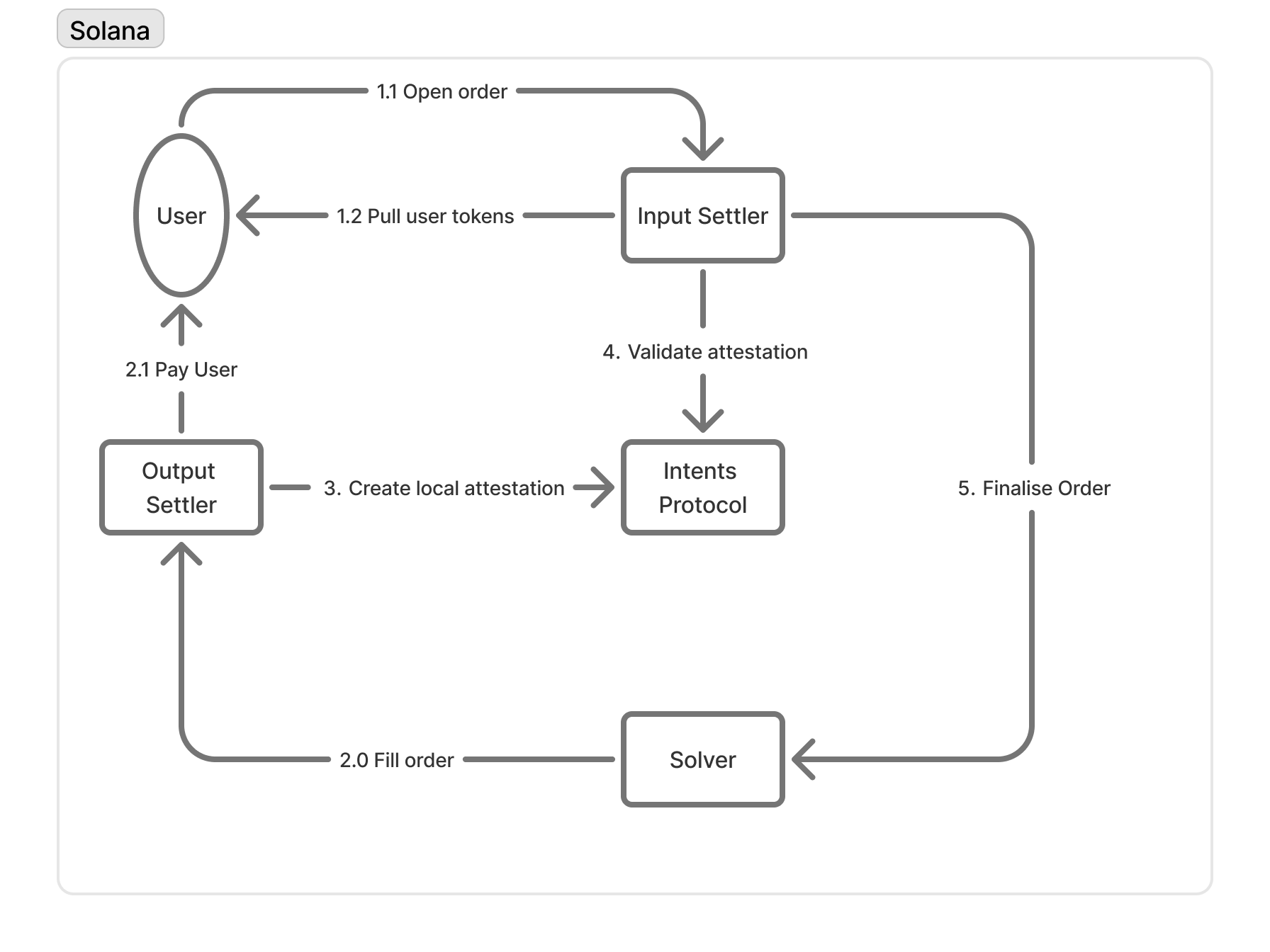
Solana-to-Solana intents skip remote proving entirely. Every same-chain order puts the output-settler state PDA in all three identity slots (settler, oracle, inputOracle) — see Which identity goes in which field. Such an order has two settlement routes:
- Standard:
fillcreates aLocalAttestation, and a laterfinalisevalidates it directly — no oracle program is involved. The attestation is not consumed, so its rent is not returned. - Input-first: input-first settlement pays the solver in the same transaction that delivers the output, so the solver can source the output from the user’s input instead of from its own balance. The compact fill creates no attestation. The order must additionally have empty
callback_dataand an empty or exclusive-limit context. EVM reaches the same outcome throughfinalise’s callback; Solana has no callback and requires a specific later fill instruction instead.
Oracles
For cross-chain orders, oracle programs carry fill proofs from the output chain to the input chain and register them asAttestation accounts. Polymer and Wormhole deployments are listed in the deployment overview. Use the oracle configured for the order and route. How these implementations verify proofs is covered in Oracle systems, and the account model they write into is covered in Attestations above.
Extending the system
The programs are composable. Each concrete program wraps a shared base crate —input_settler_base, output_settler_base, and oracle_base — that carries the validation logic. You can build new settlers or oracles on the same bases, which keeps them compatible with the rest of the system.
For custom oracle authors, oracle_base provides the shared helpers. On the output side, consume_and_encode_payloads takes (LocalAttestation, rent_refund) pairs, validates and consumes each attestation with the consumption authority the oracle passes in (Polymer’s local_consumer PDA, or Wormhole’s own state PDA), and encodes the payloads into a single cross-chain message; consume_payload handles a single proof. On the input side, decode_and_attest_payloads decodes a message the oracle has already verified and creates one Attestation account per payload. Wormhole uses it; Polymer’s receive_attest instead parses the proven EVM event itself.
Program IDLs
The Anchor IDL for each program is the machine-readable interface reference: every instruction, account, type (with Borsh layout), event, and the program’s own error codes. Errors shared across programs are in a separate catalog,errors.json. Download them here and load them with Anchor’s TypeScript client:
The four deployed-program IDLs embed the program IDs listed above. The Wormhole IDL is a source-interface reference: its embedded address differs from the published mainnet deployment. Deployment compatibility for that IDL has not been established here; do not substitute its address for the deployed program ID.
These are LI.FI’s verified production IDLs. The Solana IDL bundle page carries the rest of the bundle — the shared error catalog, the provenance record, the generated TypeScript types — and the rules an IDL cannot express: which PDAs to derive yourself, and the exact
remaining_accounts layout of every instruction.
Next steps
Oracle systems
How Polymer verifies and relays the proofs
Solana vs EVM
What differs from the EVM implementation, and why