

What this changes for you
Distribution without per-app deals
Your asset appears in flows that integrated apps already run. Nothing changes on their side, and none of it competes for a slot on someone else’s roadmap.
Buyers who hold something else
A user buys in with whatever they hold, on whatever chain they hold it, so the buyer pool isn’t limited to people who already did the work to get ready.
A price on a new chain from day one
LI.FI Fly gives users best-price swaps across every venue on a chain before organic liquidity arrives, which is the gap that usually decides whether a launch takes.
Rules that travel with the asset
Transfer restrictions are enforced as part of routing, so an app that has never heard of your rule set still can’t produce a route that violates it.
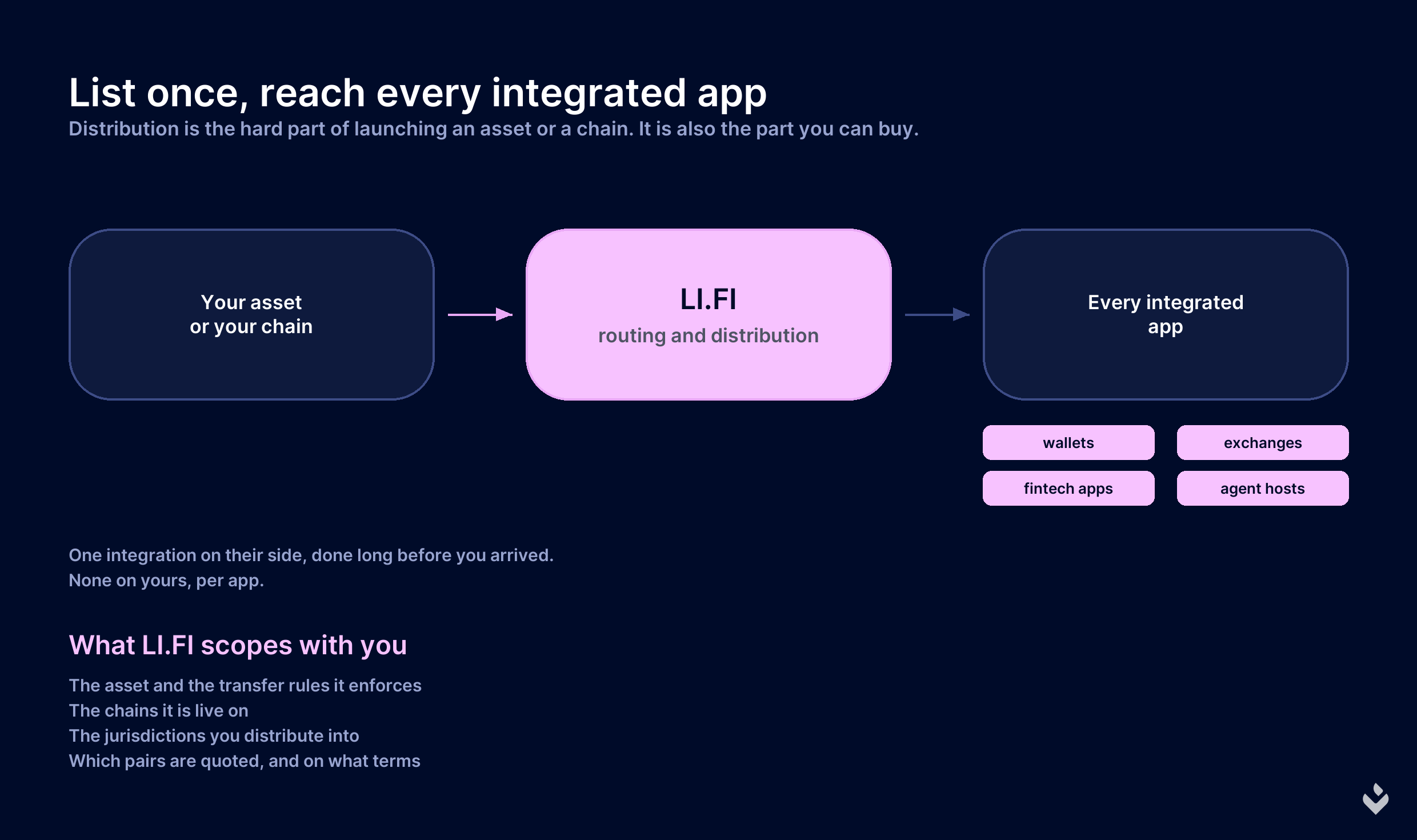
One integration on their side, done long before you arrived. None on yours, per app.
The trap this gets you out of
Launching an asset is an engineering problem for a few weeks and a distribution problem for years. The contract ships, the liquidity is seeded, and then the real work starts: getting into the wallets, exchanges, and apps where people already keep their money, one conversation at a time. For a new chain it’s worse, because the thing users want on day one is a good price, and a good price needs liquidity that isn’t there yet. Both cases have the same structural trap. The asset isn’t useful until it’s distributed, and it doesn’t get distributed until it’s useful. Teams attack this with business development, which works and takes quarters.What those apps already did
They integrated LI.FI, once, to get routing across every chain and liquidity source without maintaining any of it. That integration is the distribution channel, and it points at whatever LI.FI can route. So the work changes shape. Instead of persuading a hundred product teams to add your asset, you make your asset routable. Two pieces of LI.FI’s own product stack carry that.LI.FI Pioneer
LI.FI’s own solver. Its first job is making sure trades execute even when third-party solvers can’t fill them, which keeps coverage from being a function of who happens to be quoting. Its second job is issuer-side: launching and distributing tokenized assets across the network at scale.
LI.FI Fly
A DEX aggregator built for new and emerging chains. Users get best-price swaps across every venue on a chain from that chain’s first day, and the chain gets access to competitive liquidity including private market makers.
LI.FI Fly solves the cold-start problem at the level of a network instead of a user, and it resolves the same way: nothing works until enough is already there.
If you issue a stablecoin
Every swap that touches your token through pool liquidity charges a spread: a fee tier, price impact against available depth, slippage between quote and execution. On a dollar-for-dollar move that leakage is pure friction, and it scales with size and frequency. It’s also a reason large holders route around your token rather than through it. Stablecoin 1:1 can be enabled for an issued asset so eligible pairs are priced at par rather than through pool depth. Users across every integrated app then move into and out of your token at par, which makes size a reason to use it rather than a reason to avoid it. Setup is per asset: the eligible pairs, the chains, and the fill terms are agreed between you, LI.FI, and the solver network.If you issue a permissioned asset
The same distribution path applies, with the asset’s own rules intact. LI.FI adds it as a supported asset and resolves eligibility before returning a route, so an app that has never heard of your transfer restrictions still can’t produce a route that violates them. Tokenized Assets and RWAs covers how that resolution works from the integrator’s side.What to decide before you talk to anyone
Your transfer rules, and what enforces them
Your transfer rules, and what enforces them
Know them precisely, including where the eligibility source lives. Whether the check runs against an on-chain registry or your own service determines how the integration is built.
Which chains the asset is live on, and which jurisdictions you distribute into
Which chains the asset is live on, and which jurisdictions you distribute into
Distribution is scoped per asset, and both of those are inputs to that conversation rather than details inside it.
Which pairs matter
Which pairs matter
Par pricing and routing coverage are agreed per pair, so a short list you have thought about moves faster than a long one you have not.
Where to start
This is the one page in this section where the first step is a conversation rather than a call, because coverage is enabled per asset and per integrator. Bring the asset, the rules it enforces, the chains it’s live on, and the pairs you want quoted.Enterprise features
What else can be enabled alongside distribution.
Real World Assets
Permissioned-asset handling and the issuer path in detail.
Stablecoin 1:1
Par pricing for an issued dollar asset.
Getting integrated
The path for a bridge, DEX, aggregator, or solver.
Talk to LI.FI about listing your asset
Share the asset, its transfer rules, and the chains it’s live on. We scope distribution across LI.FI’s integrator network.