

What this changes for your product
Reconciliation stops scaling with volume
Quote from the settlement amount and the payee receives at least what you invoiced. Under- and overpayments stop arriving in the first place, so the headcount you would have added to resolve them isn’t needed.
More payers can pay
A payer holding the wrong asset on the wrong chain is a lost payment in most integrations. Here it’s an ordinary one, which widens the set of people who can complete a checkout.
Fewer abandoned checkouts
The swap, the transfer, and the payment collapse into one flow instead of three separate user actions, and each step you remove is a step nobody drops out of.
Margin you keep
On dollar-denominated flow, per-hop leakage is often the whole margin, and it’s paid again on every rebalance. Stablecoin 1:1 prices eligible like-for-like swaps at par instead of through pool depth.
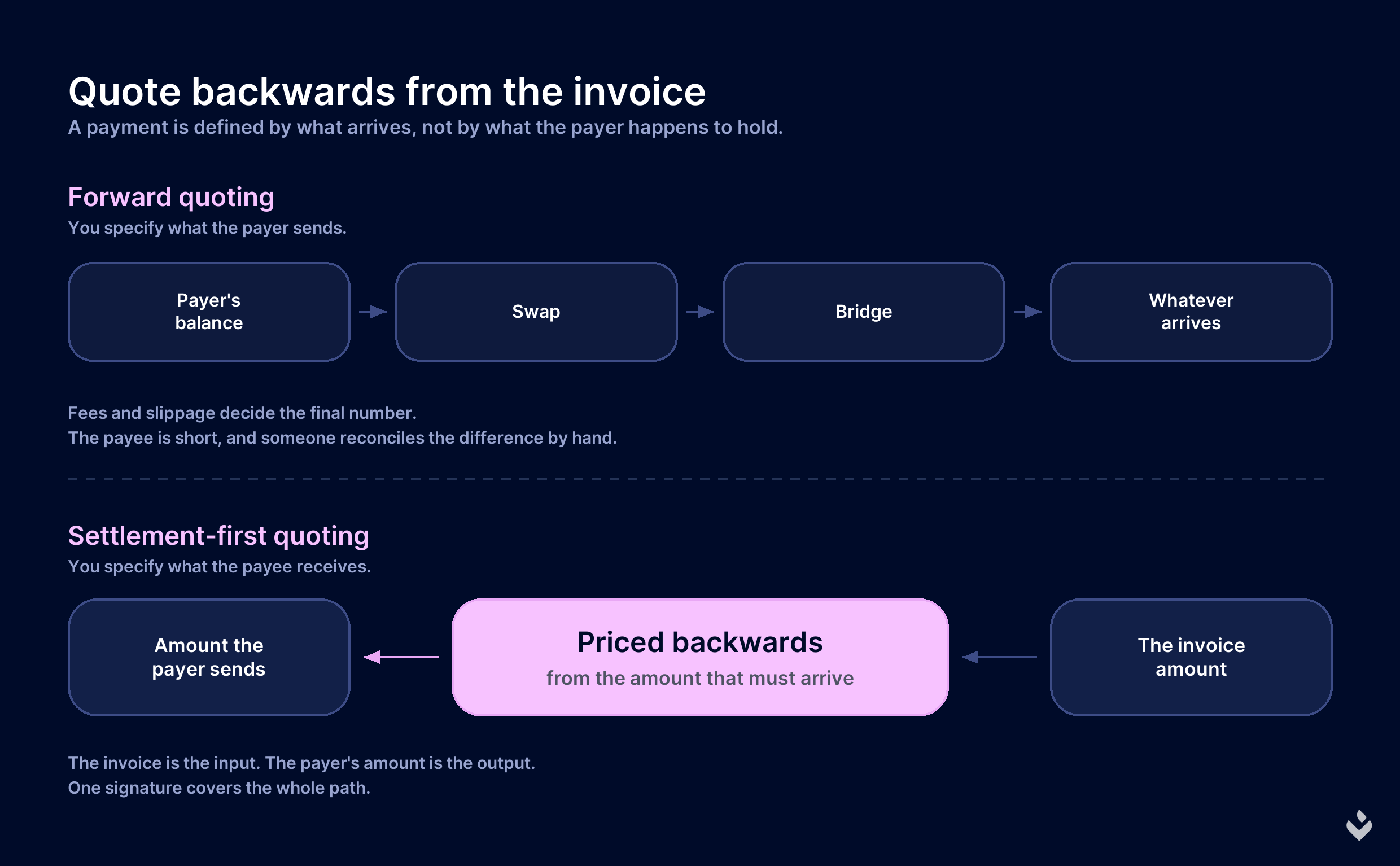
The invoice is the input. The payer's amount is the output.
Why forward quoting costs you
A merchant invoices a fixed amount on one chain. The payer holds something else, somewhere else. The common integration asks the payer to swap first, transfer second, and pay third, and each of those steps is a place the payment gets abandoned. Quoting forwards makes it worse. If the quote starts from the payer’s balance, the amount that arrives depends on fees and slippage, so the merchant is underpaid or overpaid and a human resolves the difference. At one payment a day that’s an annoyance. At a thousand it’s a team.Forward quoting
You specify what the payer sends. The payee absorbs slippage as a short payment, and every under- and overpayment is reconciled by hand.
Settlement-first quoting
You specify what the payee receives. The payer absorbs the difference inside the quote, and the invoice amount is the guaranteed minimum.
Start from the settlement amount
LI.FI quotes backwards. You specify the amount that has to arrive, and the response tells you what the payer must send. Everything in between, including transfer fees and slippage, is priced into the route before the payer sees a number. The route is sized so the payee receives at least the amount you named, which makes that figure a settlement floor. The expected amount usually sits above it, because the quote includes a slippage buffer, so your ledger should expect an overpayment of up to that buffer rather than an exact match. For flows built on the solver network, LI.FI Intents expresses the same idea as an order: fix the output amount and let a solver work out the input required to deliver it. Reach for that mode when the destination amount is load-bearing, which in payments it always is.Not every payment ends at an address. Crediting an account, minting a receipt, releasing an escrow: these end in a contract call, and the payment is only useful if the call happens too. LI.FI can move the funds and execute your call on the destination chain in the same flow. On a same-chain payment the transfer and the call execute in one transaction, so neither lands without the other. Cross-chain, the destination call runs after the bridge settles, so treat the two phases as separate states in your ledger and drive them from the transfer’s status.
The friction that loses payments
Dollar-denominated transfers need different routing defaults from trades. A slippage tolerance that is sensible for a volatile pair is unacceptable on a payment, and a general-purpose default charges the difference without telling anyone. The stablecoin preset applies defaults built for this case: cheapest-first ordering, a tenth of a percent of slippage, a price impact cap, and a shortlist of transfer paths vetted for stablecoin movement. Your own values still win wherever you set them. Two smaller things close the remaining gaps.No cold start for the payee
A payee receiving on a chain for the first time can be sent native gas alongside the payment, so they can move the funds afterwards instead of opening a support ticket.
An embeddable checkout
The Widget gives you a payment interface to style rather than one to build, which pulls weeks out of the first launch.
What to decide before launch
Two settlement outcomes need a decision before you go live, and both are ordinary.The transfer refunds to the payer
The transfer refunds to the payer
The funds return to the payer without ever reaching the payee. The invoice should stay open. Closing it as paid on the strength of a source-chain transaction is an expensive assumption to discover later.
What cost breakdown you show the payer
What cost breakdown you show the payer
Build it from the quote’s own estimate rather than by adding up every cost figure in the response. The arrays overlap, and summing them overstates the total to the person you are asking to sign.
Where to start
Settlement-first quoting is one endpoint away from a standard integration, so the fastest useful build is a single invoice paid from a different chain end to end. Add the destination contract call once the transfer works, then reconciliation states, then the preset.Exact-amount quotes
Quote from the amount that must arrive.
Cross-chain contract calls
Settle a payment directly into a contract call.
Stablecoin preset
Routing defaults tuned for predictable stablecoin execution.
Getting started
Pick an integration surface and make your first call.
Talk to the LI.FI team
Bring your settlement assets, your chains, and your typical payment sizes. We confirm eligible pairs and scope the commercial terms.