

What this changes for your product
More funded accounts
A customer funds from any asset on any supported chain and the deposit lands as the asset your ledger expects. The people you were turning away at the first screen can now complete signup.
A revenue line on movement
Every transfer through your integration can carry your own fee, set as a percentage and forwarded to a wallet you control. Funding stops being a cost center.
Idle balances that earn
LI.FI Earn turns a resting balance into a yield position in one signature, which gives you a product to sell to customers who have already funded and then stopped.
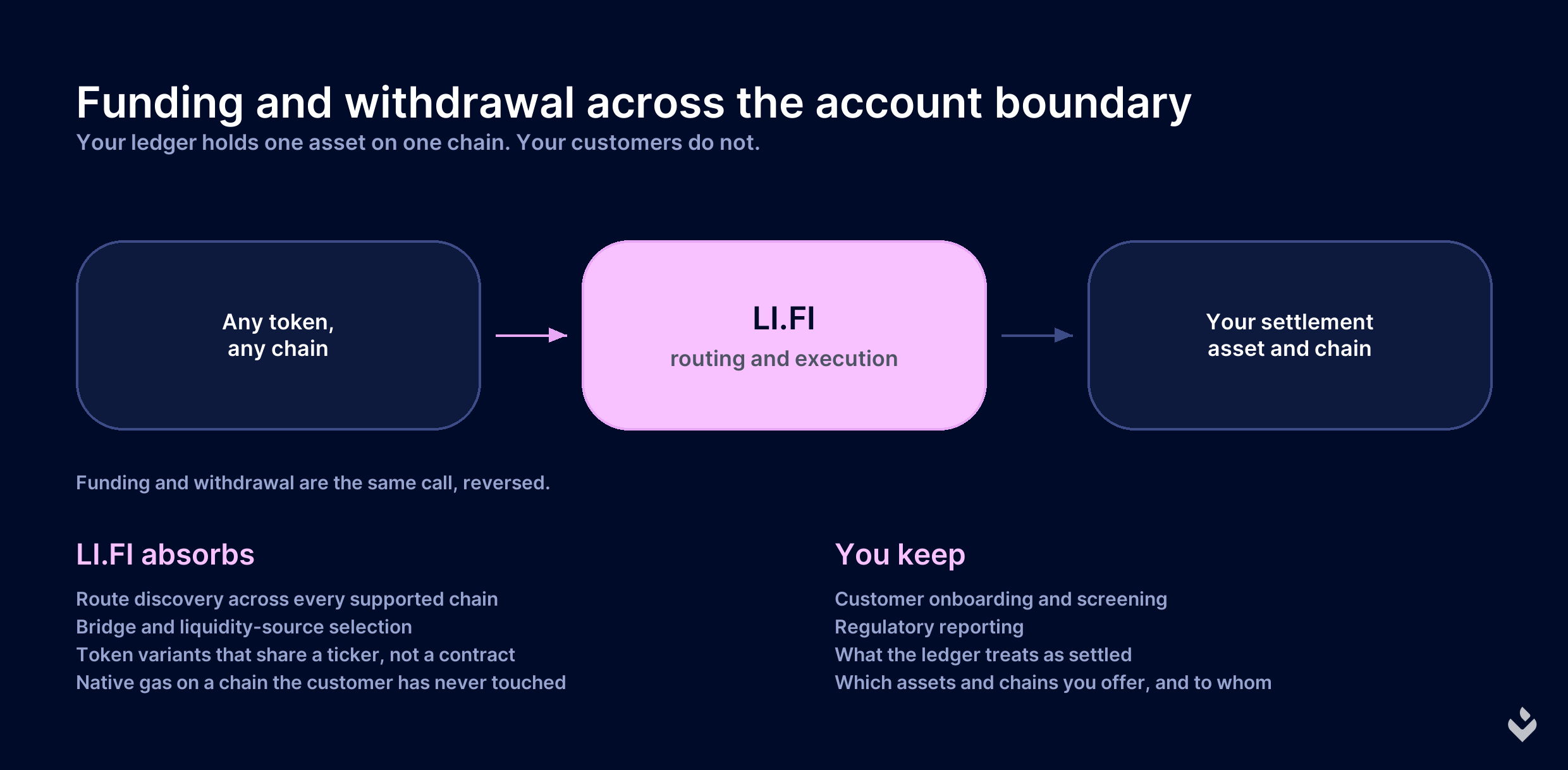
Funding and withdrawal are the same call, reversed.
What it costs you to build this yourself
You launch on one chain with one settlement asset, because that is what your first partner uses. Then a customer wants to fund from something you don’t hold. A second partner settles somewhere else. A yield feature needs a third venue. Each addition is another integration, another set of failure modes, and another thing your support team has to learn. The feature was never the work. The work sits underneath it: finding liquidity per chain, choosing between transfer paths, setting a slippage policy that suits a dollar balance rather than a trade, telling apart tokens that share a ticker but not a contract, and making sure a customer who has just arrived on a chain can do anything once they get there. Every one of those is a place a funding attempt dies, and each one you fix by hand is engineering time you aren’t spending on the account product itself.What you build
The account model, the ledger, the customer experience, and the rules about who may do what.
What LI.FI absorbs
Route discovery per chain, liquidity-source selection, token variants, native gas on arrival, and transfer monitoring under one status vocabulary.
How the account behaves
A customer funds from whatever they hold, on whatever chain they hold it, and the deposit arrives as the asset your ledger expects. Withdrawal is the same call reversed, so a customer moving out to a different chain gets a route back instead of an error message. An idle balance can also earn. LI.FI Earn surfaces yield positions across supported protocols and executes the deposit. Composer runs the swap and the deposit in one transaction on the destination chain, which is what keeps a customer from stranding between two steps. If you want the outcome without building the front end, the Widget is an embeddable interface you style to match your product. It’s the shortest path from a decision to something a customer can use.Where the line sits
LI.FI routes and executes. Onboarding, screening your own customers, and regulatory reporting stay with you, and nothing about the integration changes that. LI.FI applies token screening at the asset level, which is a different question from whether a given customer should be transacting at all. For teams moving at size, two enterprise features change the economics rather than the architecture.Stablecoin 1:1
Like-for-like dollar swaps priced at par instead of through pool liquidity, so a large transfer gets the same rate as a small one and per-hop leakage stops eating the margin.
Smart Deposit Addresses
A swap completed from a single token transfer to a unique address, with no approval and no router transaction. Suits a custodial product that can’t ask a customer to sign a contract interaction.
What to decide before launch
Who pays source-chain gas, and do you check it
Who pays source-chain gas, and do you check it
A customer still pays source-chain gas from their own native balance. Check it against the quote before you ask anyone to sign, or you’ll ship a button that fails for the people who most need it.
How the ledger records a partial outcome
How the ledger records a partial outcome
A cross-chain transfer can complete with the customer holding a related asset rather than the exact one requested. That is a normal outcome, and it happens when the destination swap couldn’t execute inside safe bounds. Decide how the ledger records it first, because recording it as a failure is wrong and recording it as an exact match is also wrong. Intermediate tokens lists what shows up and when.
Whether the on-chain side is a cost center or a revenue line
Whether the on-chain side is a cost center or a revenue line
Fee forwarding is set per integration, so decide the rate before you price the rest of the product rather than after.
Where to start
Most neobanks start with funding, because it’s the gap customers hit first and the one that costs you the most while it stays open. That is a quote request and a status poll, the smallest piece of the integration and the quickest to put in front of customers. Yield comes second, once funding works and balances are sitting still.Getting started
Pick an integration surface and make your first call.
LI.FI Earn
Vault discovery and one-click deposits for idle balances.
Composer
Swap and deposit in a single signed transaction.
Enterprise features
Par pricing and transfer-based deposits, enabled per integrator.
Talk to the LI.FI team
Bring your chains, your settlement assets, and your volumes. We scope the starting point against your roadmap and confirm which enterprise features fit.